
Tørel journal · Home ideas
Floating or Freestanding Bedside Tables: Which Suits Your Room?
Choose a floating bedside if a clear floor and a carefully chosen mounting height matter most, and your wall is suitable. Choose a freestanding bedside if you want to move it easily or avoid installing a wall-mounted unit. Measure both options: floating furniture still needs width and depth beside the bed.
Floor space and cleaning
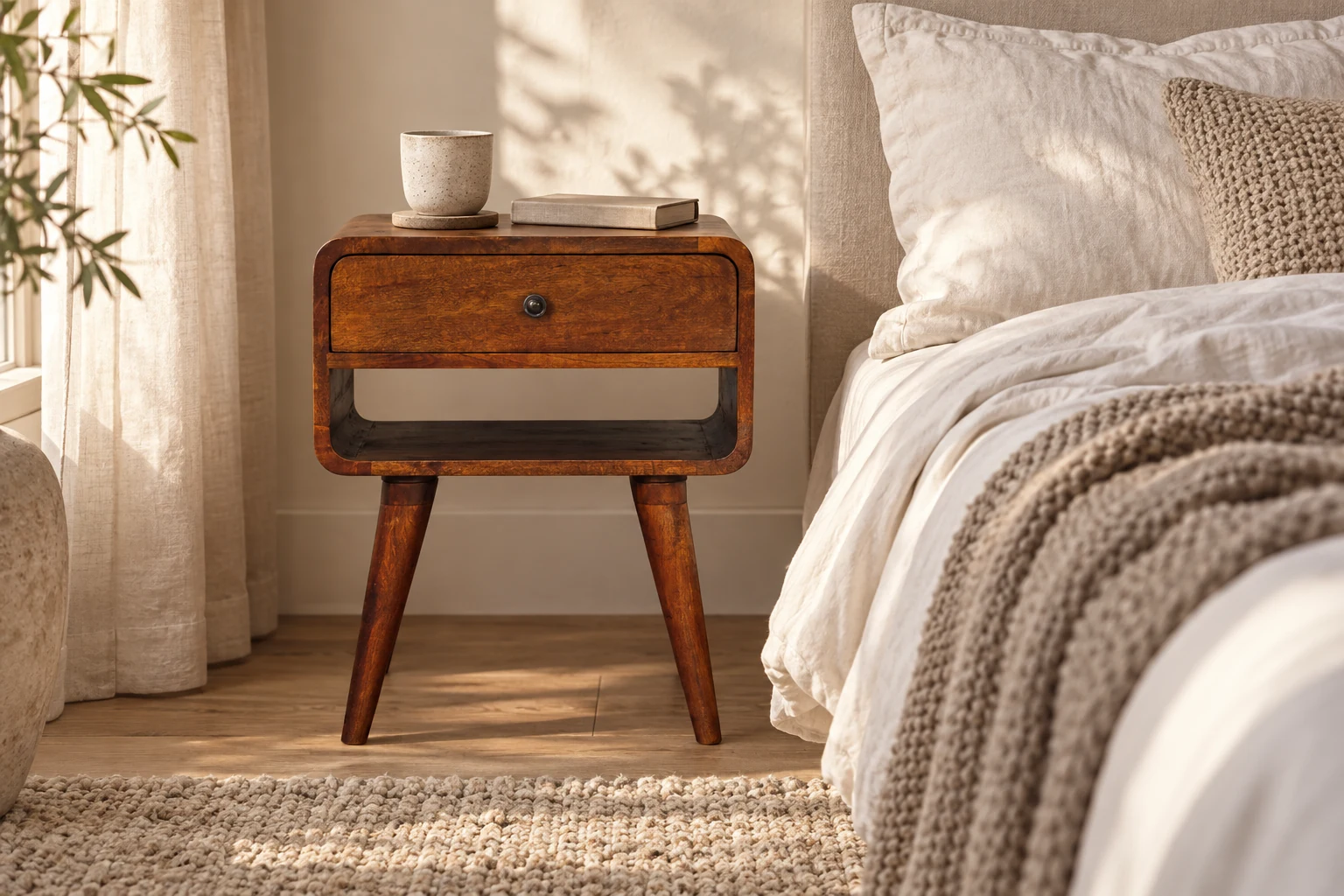
A floating bedside leaves the floor underneath accessible, which can make cleaning around the bed easier. It may also give a small room a lighter appearance. It does not remove the need for clearance beside the mattress, nor for space to open drawers. A freestanding piece occupies floor space through its legs or base; check the gap beneath it if you want a vacuum to reach underneath.
Installation and flexibility
A floating unit needs a suitable wall, the correct fixing method and installation in accordance with its instructions. Check for concealed services before drilling and seek competent installation advice where needed. Do not assume it can be fitted to every partition. A freestanding bedside can usually be repositioned more readily, but follow any assembly and anti-tip requirements. Neither style should be treated as seating unless explicitly designed for that use.
Height and everyday reach
A freestanding bedside has a fixed height, so compare it with the top of your mattress. With a floating unit, plan the top surface height before installation; its listed product height is not the mounting height. Consider the bed frame, sockets and the position from which you reach for a lamp or a glass. Mark a proposed position on the wall and test the reach before committing to it.
Storage matters more than the label
Both styles can include drawers or open shelves. Choose by what needs storing, rather than assuming one type always holds more. An open shelf suits something you use frequently; a drawer keeps smaller objects out of sight. Check usable space and any stated load limits. Product width alone does not tell you internal drawer dimensions or how much weight the unit can support.
Two different footprints to compare
The Forma Petite Floating Bedside with Lower Shelf in Natural measures 30 × 25 × 25 cm (width × depth × height). The freestanding Luca Bedside in Chestnut measures 45 × 35 × 45 cm. These are different designs, not interchangeable versions of the same piece: the Luca needs more width and depth, while the Forma needs a suitable mounting position. Use their product pages to compare the full details and selected finish.
A simple decision before you buy
Choose floating when you can confirm safe installation and prefer a clear floor below. Choose freestanding when rearranging the room or avoiding wall installation is more important. In either case, check the tabletop against your lamp, leave space for doors and drawers, and read the current delivery estimate. A matching pair is optional: choose the dimensions that work on each side of your bed.
Explore the pieces and ideas
View the Forma Petite floating bedside — Natural →
View the Luca bedside — Chestnut →